5 June 2012

Naurzum to the Karlag memorials via Astana (the new captial) and Karaghandy 26 - 31 May (To 73 deg 54'E, 5750 miles)

Demoiselle Cranes are seen everyday on the Steppes


Horse traffic jam


There isstill plenty of soviet era monumental art in Kazakhstan


A ploughed field campsite in eastern Kazakhstan


Jackdaw mobs Black Kite

We should get a signal here!

Fake cut-out police car by road

The road deteriorates again

We have found that old quarries make ideal camp sites - they are usually secluded and little visited
After Naurzum reserve we continued our perambulations eastwards towards and through the new capital of Astana. This was founded in the 1990s after independence to provide a capital easily accessible to the all the country and especially in a region where the Russian christian population and the Kazakh moselm population could both share. Previously the capital was Almaty which lies down in the south east of the country firmly in the Kazakh region. Like all new towns it was not somewhere we felt like lingering and we drove right through and on to Karaghandy. This is one of the largest cities in Kaz and grew big and prosperous as a coal mining region in the second world war when the other main Russian coalfields were occupied by the Germans. During and after the war slave labour was used in the mines.

Our slow but enjoyable travel through Kazakhstan has made us realise that we are not going to be able to achieve our initial itinerary of visiting Almaty and Shimkent in the south and maybe even a day trip into Kyrgzstan (the land of few vowels). To do so would mean a bit of a rush all the way from Almaty to Ulanbattor in view of the way the visas work. We are now heading for the Russian border east of Semey and intent to travel through Russia to Irkutsch and Lake Baikal before entering Mongolia in the north east of that country. This was the original Plan A, so in some ways we are back on course. So we will see the highland Russian Altai region on our return through the border in western Mongolia.


Common Wheatear brings a grasshopper to its chicks


Cowboy rounds up his horses


<><>
<>


<><>
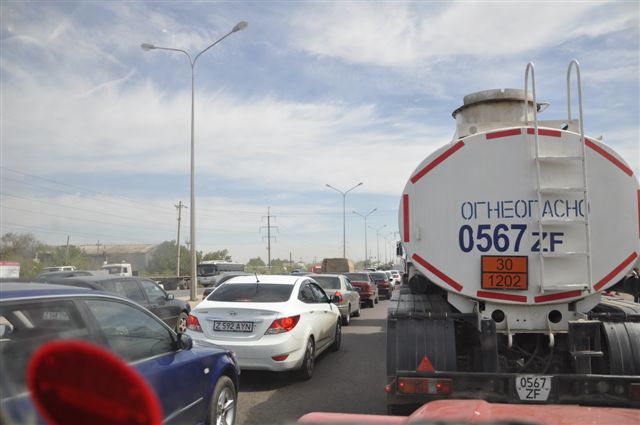
Astana traffic jam


A handy vehicle inspestion ramp at a Kaz picnic stop

Karlag memorials

Entering Karaghandy


Village scene

Traffic Police We have seen cut out replicas of police cars and card board policemen to help with the war against driving transgressions. Police roadside checks are quite frequent and we have been pulled over a few times, mainly because the police are fascinated by our vehicle and caravan and want to have a closer look. This is usually done very amicably and ends in handshakes all round. Our most recent such event took a different turn, the police pulled us over and indicated that we did not have our headlights on - a crime on Kaz roads. It was a ‘fair cop’ as they say and mike was led off to the police car fearing the worst. On the spot fines are quite steep for this sort of offence and we were shown a price list indicating at 24000 tenge (about £100) fine for the offence. However the police used the fact that we had broken the law as an attempt to extort cash from us. Particularly dollars or Euros. The bribe they wanted was actually more than the fine which did not make sense. Anyhow Mike professed to have no dollars or Euros and asked if the police could write out the form and go through with the fine. The bribe came down to $20 very quickly and then the police gave up and could not be bothered to write out the fine form either so we walked free with our honour and wallet intact.


 More on Road Casualty memorials As we mentioned in an earlier post, a feature on the road sides of Kazakhstan is the memorial stones, often with photo engravings or a ceramic photo, to the victims of fatal accidents. Sometimes these memorials are simple crosses or other insignia and at other times they are quite elaborate with carvings and fancy brickwork. Most seem to have iron fences round then (about 1-2 m square) we think mainly to stop cows and other domestic animals rubbing against them and breaking them. There seem to be an awful lot of road casualties in this part of the world. Sometimes several stones in one place. We have seen one of a family of five. On one stretch of 60 miles of more or less straight road we counted 34 memorials, those identifiably religious in nature were approximately half Moslem and half Christian. Of course not all fatal accidents are commemorated like this and we probably missed a lot. The sad thing was that so many of the pictures were of young men. Most memorials seemed to be on straight roads so it seems misjudged overtaking is the main problem.

Roadside Picnic stopsThe steppe roads in Kazakhstan have ‘picnic’ stops every few miles which are often badly littered and have toilets only for the desperate but they do have a feature which many of us would like to see at lay-bys in UK, namely a ramp you can drive onto so you can examine the underside of your vehicle and carry out maintenance work etc. This is very handy if, like us you need every few days to generally check that nothing underneath the vehicle is coming loose or getting dangerous, and more rarely to keep an eye on gearbox, transfer box and axle oil levels.. These sites are also good places to get rid of rubbish in the recepticals provided.

The Karlag memorialsJust south of Karamandy there is a field with several national memorials to the prisoners wo died as slave labourers in the Stalinist era camps clustered in the region, these were known collectively as the Karlag camps. The camps held two groups of prisoners. The first were prisoners of war captured on the German eastern front and elsewhere, including nationals of sympathetic countries. So in this category there were not only Germans, Italians, Japanese but also Romanians, Hungarians nationals and some French (possibly Vichy French?) and Koreans. The second group of prisoners were the victims of Stalin’s purges and internal transportations of undesirables. The memorials included ones from every new nation created on the breakup of the Society Union. These camps were active even for prisoners of war until the early 1950s. The rows of national monuments made for a very poiniant memorial on this barren moreland scene and both of us were quite moved.

Kindnesses from local people Whilst some people we have tried to communicate with have seemed to not want to try and understand our overwhelming experience has been one of people very much going out of their way to help us. We have already mentioned the people at the electricity office in Naurzum and the young student who translated for us - here are just a few more examples - when we asked a couple of young men where a shop was they took us there in their car; when we asked in a computer shop for something they didn’t have a member of staff took us to a shop which had; when we were having trouble meeting up with Mike’s contact Evgeny a driving instructor and his pupil interrupted their lesson to speak with him on the phone and guide him to us and the pupil also rang a friend who spoke some English and offered to find us an English speaking student to come and help us out; a young man in the shopping centre shut up his shop - twice - to help Mike find some gas and made phone calls on our behalf.

PS An update on the birds seen so far during the trip (to 31 May) and a list of all the waypoints of campsites etc will be posted on the file sharing site mentioned on the birds page.

30 May 2012

Naurzum Nature Reserve (ca 51 34' N, 64 15' E, 197 m asl) 21 - 25 May

Many villages & towns have elaborate sign posts at their entrance, this is the one for Karamendi for the Naurzum reserve
Mike attempts to go on line in the reserve guest house
Whilst Carol was photographing these 3 ticks their mates all jumped into one of her shoes (see previous post)
The warden's garden

Mike spots something rare - or so he reckoned
There are many shallow, saline basins in the reserve - they were particularly low when we visited after 3 very dry years
Mature pine forest in the reserve
Fresh water lake -  where we saw 2000 Red-necked Phalaropes


We arrived in the village of Karamendi looking for the Naurzum Nature Reserve in mid afternoon on the 21st and whilst trying to find it we misread the sign for the Naurzum electricity office. There was quite a lot of confusion on everyone’s part about what we actually were doing in that office but a call to Mike’s contact Evgeny soon sorted it all out, embarrassment all round! In the meantime the electricity office staff ushered us into a common room for tea with various members of staff who quizzed us about our trip. When we asked how we could get to the reserve office we were told that in a few minutes someone would come for us. Sure enough one of the scientists there, Kanat, came over with a hastily found translator, Botagoz, from the local school, and they took us to the reserve HQ nearby. Botagoz, at only 16 years old, spoke excellent English, mostly self taught - she wants to study English & Chinese at university and become an interpreter. With Kazakh and fluent Russian already we feel she will do very well.

Having arrived we were given a tour and shown photos etc whilst we waited for the Assistant Director Maria Zinyelova to come and sort out our passes and some accommodation for the night. We then stayed in one of the centre’s guests houses so we could shower and recharge all our batteries, that’s literally, we need access to mains electricity every 10 days or so. We had also hoped to post a blog but the signal wasn’t good enough.

The next morning we were met by Maria, Kanat & Kseniya another young woman who spoke good English. She acted as our interpreter for the morning and came with us to the Centre’s house about 10km into the reserve. There we were able to park up in the back garden for three more nights under the care of Albakir one of the wardens & his wife. They were very kind (see Coeliac/food page) and we had use of their outdoor loo (long drop) and shower which provided warm water by solar radiation.


The Naurzum reserve was established 80 years ago in 1931 but it has seen various changes of direction over the years depending on the soviet regime of the time. At one point it was closed down and at others the local Commissars interfered with management on political lines. There are plantations of alien tress in the reserve which originate from this era. Today the reserve is split into three main study areas and the zone between has farming and herding activities compatible with the objectives of the reserve. The total area of main reserves and control areas is over 200,000 ha.

We visited the main ‘Naurzum’ section based on the village of that name. The main habitats in this section are ungrazed steppe grassland and heath, conifer woodland, birch and poplar woodland, saline lakes and dry basins, and freshwater lakes and ponds. There are a number of springs and small streams in the reserve but no significant rivers. Introduced trees in plantations are similar to those seen elsewhere in Kazakhstan, mainly a sort of elm (judging by the leaf and bark or it may be a hornbeam). Most are dead or dying from lack of water. There are also lines of conifers (which may be alien) planted some years ago. There are very few tracks within the reserve and the level of disturbance seemed light.

This part of Kazakhstan being positioned between the east and west palearctic regions, receiving northern visitors and adjacent to the Indian subcontinent, will inevitably have a huge list of birds. Since records began here 340 species have been recorded but as might be imagined many are vagrants to the region. We had some of the reserve specialities such as Imperial Eagle and Little Bustard but we did not see the Sociable Lapwings that breeds in the park. One notable observation was a flock of over 2000 Red-necked Phalarope on a fresh water lake on 23 May, but the next day they had all gone.

Many thanks to Evgeny Bragin for showing us some eagle nests in the reserve and an elk (moose), the only large animal we had seen there although several others are known including Red Deer, Wolf and Wild boar. Some more details of birds seen at the reserve are shown on the file sharing site mentioned on the bird page.

There is a beautiful grass in the reserve, and much of the steppe generally, which has long, trailing filaments which look like hair blowing in the wind

Two mature pine trees

View from the warden's garden

Mike goes for a solar assisted  warm shower

Mike with Kanat and Botagoz

Carol with Botagoz and  butterfly

Kseniy, Maria Zinyelova (Deputy Director) and Mike

Our latest adoptee - another dog with no name

Carol gets the bug

27 May 2012

Pictures for Aktobe to Kostanay post

School kids (age 10-11) - see more below

Endless roads across endless steppe! (3000km so far)

Many of our routes run beside the railway

Golden Oriole


Road stop near Denisovka

This reminds us of Ely Cathedral (Ship of the Fens), many towns in northern Kaz have huge "cathedrals" to collective agriculture in the form of grain silos like this one at Denisovka.  Many of these appear now to be in disuse & dilapidation

The only rock outcrp we have seen on the steppes so far was this river gorge at Denisovka, this was also the site of the only Common Ravens we have seen in Kaz so far.

Gate guardian to a collective farm

Entering Rudnyi 

Our first forest camp - and ticks

Filling a jerry can at a village standpipe

This chap explained the intricacies of the workings of the standpipe to us, as we could not get it to work.

Local shop keepers

More school kids

Mike is asked for his autograph! It was quite chilly that day but the little girl seemed to be dressed for winter!


Handsome spider - body & head about 2.5cm, colours suggest it may well be poisonous

Dilapidated farm buildings from Soviet era

Imperial Eagle nest campsite


One of many dusty drives in northen Kaz - note bumps signpost which should actually say 200km

Carol joins the war against dust!