26 May 2012

Aktobe to Kostanay 16 - 22 May (64 deg 04'E)............ (Posted 26 May)

Buying petrol in Ukraine, Russia and Kazakhstan is not quite a straightforward as back home where you fill up your machine then go and pay on your card. For a start not many garages take a card and not any in Kaz yet. You have to pay first which means you have to estimate how much you need. Most local people seem to hand over a sum of money and get the volume in litres and part litres. Or you can ask for a set number of litres.and pay the price. Problem is the garage cashiers often sit behind very small windows or a glass screen and do not speak much, if any, English and of course we do not speak much of the local lauguages. We found the easiest way was to write the required number of litres on the palm of your hand e.g.‘40' and press it to the cashiers window and say ‘litres’. This seems to do the trick - they then show you their calculator which displays how much you need to pay. After paying an attendant appears from nowhere and puts the required number amount in your tank. Sometimes you are able to put it in yourself but the pump stops when you get to the volume you have paid for. We have not found a single garage in Kaz that has water easily available, if at all - you need to go to a village and look for a standpipe.

The school kids in Kaz are great, it seems the boys uniform is often a mini lounge suite and the young girls a black dress with a sort of white lacy waitresses apron over the top. We found the girls outfits quite bizarre at first but when we thought about it both of us had seen photos from the early 20th century of our own females relatives in similar white aprons in school photos. We chatted to one group of school kids in a village and in no time at all there were nearly 20 of them all clustering round, including 2-3 teachers, all wanting to practice their English and get our autograph. We have found that whilst the older generation, 40+, rarely speak any English almost all school age kids speak a little - apparently everyone is now taught English at school along with Kazakh & Russian.

The northern steppe between Aktobe and Kostanay were at one time huge collective farms. They now mainly owned by big businesses. We thought the farms in Ukraine were big enough but these ones are enormous. Tractors go over the horizon before they finish ploughing a furrow. There is also however a lot of abandoned land or fields that have been lying fallow for many years. Water is probably a problem and in dry years not much grows. Everywhere one sees evidence of the old soviet collective farms lying in ruins and decay. Derelict grain stores, old animal barns robbed of the roofing, old combine harvesters rusting and many villages in a state of decay & depopulation as so many people have left for the towns now that the collective does not promise a job to all. A number of small towns had huge grain silos overshadowing them but no areas under cultivation for miles around and presumably now no longer in use.

One of our most enjoyable camp sites so far (one of many) was on the way to Kostanay just north of the village of Livanovka. It was ‘big’ farming country and we were beginning to despair about finding anywhere. We turned off the main road along a dirt road which clearly let to a village (signposted 38 km) and after about five km we found a large patch of fallow fields (probably been fallow about 10 years) which were dissected by rows of birch and popular trees planted as wind/snow breaks. We drove a couple of km off the dirt road across this fallow (not easy as the plough ruts were still there) and camped up in the shade of some birch trees - see picture. Immediately on getting out of the car Mike spotted the nest of a pair of Imperial Eagles about 500 m away with two birds attending. We saw them several times over the next 16 hours but they were very skillful at approaching the nest behind trees. There were also breeding Hooded Crows, Magpies, also two pairs of Red-footed Falcons and a pair of Kestrels seemed to be disputing a nesting site in a old crows nest. Grey Partridge, Pallid and Marsh Harriers, Booted Warblers were a few others and as Little Bustard showed itself in the late afternoon. Lots of Common marmots had colonies in the field but our trail camera only succeeded in getting head shots. We also saw a couple foxes.

Our route took us to Kostanay which at 53 deg North is the first place on our trip so far to be further north than the fens where we started. There were more trees here than we had seen on the steppe proper. The diversion was to meet a contact of Mike’s, Evgeny Bragin who has been responsible for ringing many Imperial Eagles in Kazakhstan’s Naursum reserve, which have turned up in Arabia in winter and so come within Mike’s sphere of interest. We met with him briefly for a cup of tea the morning of the 21st and arranged to see him at the reserve on the 24th.

At Kostanay we needed to get a truck stop overnight camp, this one had no facilities at all but it served the purpose. South of Kostanay on the way to Naurzum reserve we had our first forest camp. There are islands of sandy outcrops in this region unsuited for agriculture and as a result were delightfully wild with forests of pine, birch and poplar. Our camp was just north of the town of Awliyekol. We turned off the road at a picnic site and were able to drive much further into the forest where we found a nice secluded little glade. Two new butterflies were immediately apparent but there very few birds. We did find a Great-spotted Woodpecker’s nest only about 30 m from where we pitched the tab, two adults feeding young. Also a dueting pair of Common Scops Owls. The common pigeon of these woods is the Oriental Turtle Dove, a bit bigger and heavier than our Turtle Dove.

Throughout the Ukraine, the part of Russia we saw and here in Kazakhstan we have seen many roadside shrines, we assume to people who have been killed in car accidents (as are starting to appear in the UK). In these countries though actual headstones are placed next to the road and each has a photo engraving of the person(s) concerned on it - other than where the victim was a Muslim and there is a crescent instead. We have found this to be quite poignant as actually seeing a face (usually young-mid age men) really brings the tragedy home to those passing much more strongly.

There is now a bit of a war going on with mozzies. They have been around for a while, there are several types and some are not like any we have come across before. Three burning coils and lashings of repellent just about keep them away but this lot never sleep, they are present all day and are big things with a voracious appetite. At least there is no malaria but Mike has a bad reaction to bites and they also can carry other nasty diseases, as well as just being unpleasant to be around, so we are trying to keep them at bay.
We had our first tick in the wood near Awliyekol. We are not talking here about ‘lifers’ for a twitcher but arachnids, the carrier of tick-borne encephalitis. We had half a dozen sitting at camp and Carol found one in the bed the next morning. So there is now a second front in our battle with the wildlife. Ticks are commonly found in grassland and forest areas but seem to be very local within this but we are not sure what specifically they prefer. They are a great way of spoiling a good walk. It is hard to walk here without brushing up against the grasses etc which they collect on and it is easy to get paranoid about them crawling up you to find a nice nook or cranny where they can attach themselves. We both had lots on the morning of the 24th and when back at base Carol took her trainers off and a whole ‘nest full’ surged forth. This trip is not all fun! Although we have 90% protection through the vaccination against TBE, ticks also carry many other unpleasant diseases so again we have to be a bit careful - the tick tweezers have now been moved from the fist aid kit to our day bag but we have not had to use them yet!

18 May 2012

8 - 16 May: Astrakhan to Aktobe (58 deg 16' East - 4200 miles)


Volga delta fishermen


Two fifths of the Astrakhan slipper thief gang

Our first view of the Volga, before it starts to split to hundreds of distributaries

Lenin (in coat) and Mike in Atyrau

The Kremlin Astrakhan

Rickety pontoon bridge on the way to the Kazakhstan


Carol had to be dragged away from the puppy heaven that was the Astrakhan truck stop and we headed east 100 km to the Kazakhstan border.  The formalities on both sides were done quite efficiently although it still took just over two hours, that’s with a 10 km drive between the two border posts.  Almost immediately into Kaz we saw some camels (picture posted earlier).  They had two humps - on all our travels in Arabia we had only seen one humped camels.  These looked so strange.  Once through the Kaz border we had a night to use up before our booking at an Atyrau hotel.  Having a hotel appointment on arrival seemed to be a condition of getting a visa but no one checked at the border.   We decided to camp off the road (our first wild camp) on the way to Atyrau.  We chose to camp about a kilometre from the road near a  disused oil administration building and about 200 m from a small farm that seemed at the time deserted but later spewed out a good sized herd of cows, sheep and goats. The herder came over to see us and try our tea, nice guy but did not say a word even in kazakh.  Later on two policemen arrived from nowhere to ‘say hello’ we suspected the farmer called them just in case we were some kind of subversives.  The police visit was all very amicable and they were pleased to be shown the inside of a Tab.  The only excitement in the night was the herd of 30 odd cows outside which started jostling, as cows do, and rocked the Ta b at one point.   The next day we were glad for the comfort of the hotel and we even decided to stay an extra night, once we had established that we were unwilling to pay any more per night than we had booked on the internet - as the hotel had suggested we should.  It was all the same the most expensive event of the trip so far at £150 for two nights.  Most hotels in town are much more expensive as Atyrau is a prosperous town benefitting from the developing oil exploitation industry nearby.

Europe officially ends at the Ural river that runs through Atyrau.  We first felt the Asiatic influence in Astrakhan where many of the people are oriental in appearance but by the time we got to Atyrau these people were in the majority.  There are of course many people of Russian descent in the town, indeed in much of Kazakhstan (about 30% in 1999),  as a result of many years of Russian influence and settlement in the region.  Kazakhstan is actually a secular state despite Sunni Muslims being the largest religious group.

At Atyrau we had a good day in the Ural marshes to the south east of the town on the Asian side of the river. We left the Tab at a hotel for the day. To get to the marshes you need to make your way to the village of Damba and then continue southwards along causeways across the marshes, or to be more precise through the reed beds.   Unfortunately the tracks all ended in channels too deep for the vehicle to cross but it was nice to get the Land Rover really muddy at last.  It was not possible to get any good views of large expanses of water or mudflats because of the high reeds in every direction but all the same we had some good birds. Lots of Pygmy Cormorants, Night, Purple and Grey Herons and Glossy Ibis but only single examples of Spoonbill and Little Egret.  A few Dalmatian Pelican overhead and a couple of White-tailed Eagles.

On our first night in the steppes we discovered that there is a shortage of wood and twigs for our kelly kettle, which we use as much as possible to save gas.  After a few days of the steppes we have become really frugal, saving all paper and cardboard and picking up bits of wood lying around by the road.  We have even used dry cow dung, which we find burns odorless a bit like coal, but is not such an efficient fuel as wood.  We are not yet in a position to be able to say whether horse, camel, cow or sheep droppings are our preferred animal derivative fuel on the steppes.

As we pulled into to have lunch on the 12th a Land Rover Discovery with a roof tent arrived in a cloud of dust.  It was a couple from Switzerland, mother Sarah and son Mark.  They are also on their way  to Mongolia.  They could not stay long because they had an appointment to see a rocket go off at Baikanour cosmodrome on the 15th.  They were planning to get to Aktobe that night - a journey we were planning to take five days to do.

Some nice birds on the Steppe so far, several pairs of Demoiselle Cranes, lots of Steppe Eagle including some on nests.  One nest on the level ground could be driven right up to with the Tab.  - it had two eggs.  Other birds included Red-headed Bunting, Black Lark, White-winged Lark,  Rose-coloured Starling,  Ruddy Shelduck and Sociable Plover.

As we have headed north the weather changed considerably - we were consistently having cloudless skies and temperatures in the mid 30's but a nasty wind has started blowing from Siberia. We had a couple of storms - one with big hailstones (but still at still 33C) - which really felt to be battering the Tab but seem not to have left any marks. Then it started getting cooler and the wind stronger until just before Aktobe it became gale force and the temperature dropped to 17C with a very significant wind chill - the night of the 16th was even down to zero, the lowest since 19 April in Czech.

One of the great things about having the Tab with us it that it  makes people, children, elderly folk and border guards, almost without exception, smile. Here in Kazakhstan we have had many toots from other cars and then waves. At the supermarket one day a woman asked if we were with a circus!

We have added notes on the coeliac page and about buying fuel in this region on the home  page.

We meant to say last time that as well as appreciating your comments we have also really enjoyed hearing your news and that of home - so please keep that coming - we especially enjoy hearing how bad the weather is in the UK!

The road from Atyrau to Aktobe (596 km)

This is the only road from this western city to the center and east.  It starts off fine and having had a little experience of Kazakhstan roads since the border, we thought how long can this last?  We got to the town of Dosser (101 km) and it was still excellent and then on to Maqat another 30 km still fine.  Unfortunately we could not find the road east from that town until we realised that a very rough unasphalted track was the road..  The next 260 km were really terrible.  At best the official road was asphalted or was hardcore more or less graded but both these surfaces were so heavily potholed and broken up by the elements that unofficial roads had been created both sides of the road where cars had left the road to form parallel tracks in the steppe, usually within 100 m of the main road but sometimes 2-3 kms from the main road.. The big problem of these tracks is the dust.  Clouds of it.  The silty strata which compacts after rain breaks down to fine billowing dust which lies in pools and explodes from the ground when you drive over it.  It gets in everywhere. Including a fine covering inside the Tab.   Had we not been towing the Tab we could have gone a lot faster but the Tab is not good over large bumps and uneven surfaces or corrugations (the rippled surface that forms on well used sandy tracks).  We were not in a hurry in any event and this rough section took four camp sites with our lowest daily mileages so far.    About 30 km east of Bayghanin (56 deg E) the road improves and is mainly asphalted but of poor quality and still with anumber of  potholes and rutting for the rest of the way.  At least you do not have to leave the road very often.  We had two more camps before Aktobe.  It took us six days all told of about 4-5 careful hours driving a day but it can be done a lot quicker.  The couple we met  from Switzerland in a Discovery were planning to do the whole journey in one day and we understand they made it but it would have been a long hard day.

The herder and his dog at our first wild camp in Kaz

Our first wild camp - the road is a disused oil company track, not the highway -which was worse!

Road near Maqat

Steppe camp site - several more like this.  Look no neiighbours

Sarah and Mark from Swiitzerland  - on the way to  Mongolia via Baiikanour

Mike enjoys his Easter egg - thanks Lin and  Ed

Another campsite on the Steppes

One of the secondary routes which is actually better than the main road

Steppe Eagle leaves its nest - see below - on the bare ground


Our first day with our sun canopy 
See more pictures on the Kazakhstan page.

The next leg is to Kostanay (767 km).    

14 May 2012

14 May Eastern Kazakhstan

We are having trouble getting into our Gmail accounts and the blog which we have not been able to check for over a week.  Does it look OK that end?  Normal service will be resumed as soon as possible.  Meanwhile here is a  of our first camels.

10 May 2012

10 May (Atirau Kazakhstan 51 deg 54' E (3700 miles and 4 time zones so far): Eastern Ukraine and Russia


From Dnipropetrovsk the fields seem to get bigger and bigger with fewer and fewer villages,  we think Stalin had something to do with the depopulation of this area.  Camp stops are beginning to become a bit of blur in the memory  3 weeks into the trip, but the last but one in Ukraine was spent in the car park of a very nice motel (Ismailovski Dvor www.motel-ukr.com.ua), where we had a  warm welcome from three friendly women, and the last was a truck stop close to the Russian border.   One village in the east of Ukraine was selling strawberries - they were delicious (Carol reckons Mike was fleeced by the lady selling them).  Eastern Ukraine is a big coal mining area - or to be precise, it was.  Everywhere you see huge slag heaps and large mining equipment and railways going everywhere but most of the pits seem to be closed and delapidated.  Another characteristic of the area is lilac bushes, all in flower as we came through, adorning every garden and a lot of the rough ground too.  The   fragrance wafted into the car on occasions.   The national pastime (for men & women) seems to be angling and most lakes and rivers has a retinue of these patient hunters.  The banks were particularly busy during the public holidays of 1 and 2 May.  We got to the Russian border early on the morning of 3rd May.  It took us 2 hours 20 mins to exit Ukraine and enter Russia which by all accounts is quite quick.  We had expected a difficult time but we did not get it, in fact we found all the officials on the Russian side especially helpful.  Getting the Tab in was not a problem as had been suggested by some, but we were glad we entered the Tab serial numbers on the vehicle V5 form, which seems to work.  (See ‘Home page’ for some extra comments on border procedures vehicle insurance etc).

Russia was not instantly different to Ukraine, it was of course the same county only 20 odd years ago but the countryside changes subtly every day.  At first there were huge wheatfields, with growing wheat (it was still being planted in Ukraine)  but this gave way to grassland and true tree-less steppe as we sent south from Volgograd to Astrakhan at the mouth of the Volga river to the Caspian Sea.   This bit of country is basically like Arabian sand dunes with grass so we felt quite at home.  The Volga is huge, at least a kilometer across, and at this time of year is in flood with many low pastures inundated.and all kinds of debris floating down river, including whole trees.   Astrakhan is the last town in Russia before Kazakhstan, where we had another truck stop.  Another Land Rover zoomed by us on 5th as we were having lunch - tooting, the first we had seen since Slovakia.  Plenty of big flash Range Rovers though, we imagine the vehicle of choice of the well-to-do local gangster!  After the mini heat-wave in central Ukraine the weather got cool again for a few days but by the time we got to Astrakhan it was hot once more  and may stay that way until the Altai mountains at the end of June.  On the 4th Carol had a moment (well two in fact) of madness when we got lost (we feel there is rather a dearth of signposts) and decided to ask a policeman the way. Having heard from various sources how the Russian police will take any opportunity to stop & fine you/solicit a bribe, she also then threw caution completely to the wind and crossed the road to park on the wrong side of the road - an offence in Russia. We were duly given a long lecture in Russian which we vaguely understood meant we had broken the law and our Green card was taken away for inspection. We were then left to sweat (also literally in the hot sun), Carol feeling somewhat sick,  for 10 minutes or so awaiting out fate. The policeman then returned smiling, asked to see our road map and sent us off in the right direction! Phew! In the Ukraine the police are marked ДАI and in Russia ДПС. In our experience they mainly occur just before towns & villages and there are signs several km in advance so you know to slow down. Occasionally they were to be found just over the brow of a hill or round a corner with no warning but cars coming in the opposite direction had usually been flashing us. We only had a couple of weeks’ experience but we passed a lot of police and were only stopped a few times and each time the police were very polite and friendly, perhaps asked us for some ID and where we were going then confirmed we were in the right direction and wished us luck. We imagine that avoiding the big cities is an advantage?
  We saw our first dragonfly on our second day in Russian but didn’t manage to get a great pic. We also saw masses of Clouded Yellows near the Volga but didn’t get any pics at all! The steppes and the Volga lowlands are the domain of the Calandra Lark and the Isabelline Wheatear.  The latter is a common winter visitor to Arabia and so it was nice to see them in their typical breeding habitat.  Other nice birds have been White-tailed Eagle, Red-footed Falcon and Montagu’s Harrier, Red-crested Pochhard, Ferruginous Duck, Golden-eye, Red-necked Grebe - to mention a few.

Our truck stop just north of Astrakhan had a very good shower and the added attraction of five  puppies playing round the van endlessly. We ended up staying there for 3 nights and doing a couple of day trips out with the luxury of leaving the TAB behind & just taking PYJ. The first night Carol left her crocs outside and was very upset in the morning to find they had disappeared. Initially assuming the worst of our fellow ‘campers’ we then remembered that a certain puppy we used to know (see Charities page - Hearing Dogs) had a penchant for shoes and sure enough Mike then found one Croc in the puppy den and another a bit further away - along with four other shoes!

We will provide details of our first days in Kazakhstan in a future post.

See the way-points file posted to the file sharing site which gives precision to camp sites etc.

Thanks for the comments we are getting on the blog and in emails and texts.  Sorry we are not able to reply to them all individually but our time on the internet is limited.  But keep them coming it is a great encouragement us.
Mike buys the first Ukrainian strawberries  of the season and pays the price

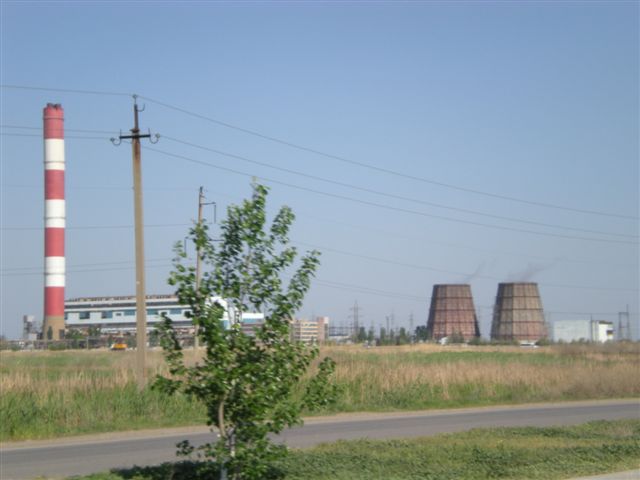
A Ukraine power station - or something like that

Large pipes snake across the countryside , gas?

Derelict coal mine lift, Ukraine

Lots of lilac in the Ukraine villages - also next picture


High rise flats in Ukrainian coalfield area

Last lunch stop in the Ukraine

We race a train across the steppes

Military monument eastern Ukraine

Our first truck stop camp site in Russia en route to Volgograd - all mod cons!!

A church in Russia - this one was old, many in Ukraine were new

Dried fish for sale at the side of the road along the Volga river

One of many noisy marsh inhabitants - see video above 

30 April 2012

30 April: to Dnipropetrovsk 35 degrees east (2352 miles so far)

By the way, in case you do not know, our home in the fens sits on the Greenwich meridian, to be precise it runs between the fruit cage and the ash tree in our back garden. So the degrees east mentioned in the blog are a precise measurement from our home.


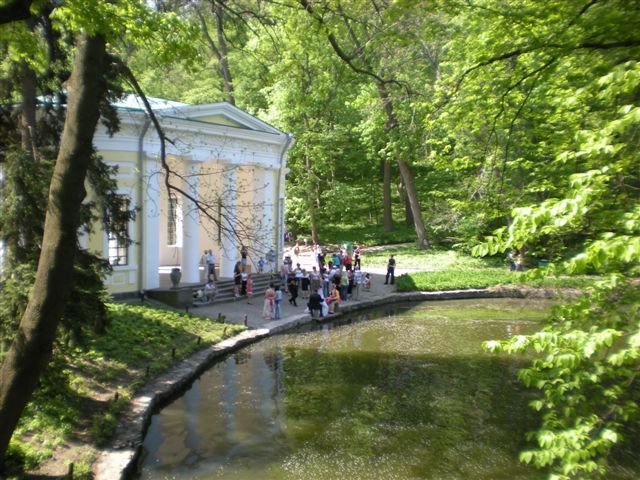
On 29th we visited the Sofiya gardens in Uman. These beautifully wild gardens were laid out in the late 18th Century by a love struck Polish count in honour of his Greek wife Sofiya. They cover 200 or more acres and are filled with mock caves, cliffs, grottos, statues, waterfalls and lakes. Sofia cheated on the count so it did not end happily. The park is now mostly a botanical garden with lots of wild flowers. We visited the park on a Sunday when everyone goes there to promenade, and it is a favourite place for new brides to have their picturers taken. We saw a Wryneck there (sort of woodpecker).

On, on, ever onwards, east, and by the evening of 30th we had reached Dnipropetrovsk a large city. We were both feeling tired so we decided to take a hotel for the night. The Comfort Motel (http://www.comfort.cc/) is brand new, we reckon we are the first guests. It is all ready to be wrecked by football fans in a few weeks. The last 300 miles have mostly been huge fields all ploughed up and harrowed and being drilled. We understand wheat and sunflowers are the main crops but we have seen several fields of rapeseed already in flower. There have been far fewer villages and we have missed seeing all the local produce for sale by the locals at the side of the road. We hope to get pics for posting later. The main products for sale are apples, potatoes, honey & eggs. Lots of vans bussing 50 or so hives of bees around on carts - we would hate to have an accident with one of those. We noticed how rubbish free the roadsides are and have seen several teams of people (mainly women) picking all the litter up.


See update pics in the Ukraine, Coeliacs and Inverts pages.  Mike will also add the April bird sightings on the file sharing site.

Carol just can't resist a cute dog.

Sofiya park Uman - and next photos


Mike calls room service in Dnipropetrovsk

Just before we left we bought a little gadget called a Kelly Kettle.  It is a stainless steel jacket which is filled with water and then a small fire is lit in the base.  It works like a dream and boils a litre of water in just a couple of minutes.  Any old bits of wood or dead plants laying around are all the fuel you need. You can also cook on it.

Carol and wildflowers, Sofiya park, Uman

28 April 2012

28th April: To Central Ukraine at 29 deg 42' E. (20 miles west of Uman, 1996 miles so far)

Stork on nest - common in Ukraine villages

Lunch stop in western Ukraine

Lorry park campsite - the woman in charge made us camp next to the only other lorry in the place. 


Levoca
 The second day at the excellent Levoca camp site was marred by far to much rain but before we left on 25th we had heard Tengmalm’s owl there and found a pair of Hawfinches nest building. We moved on towards the border not quite knowing where we might camp or where we might get to. The countryside changed from pine clad hillsides to open undulating farmland with a rather high population density. There were several White Storks already nesting in many villages but the area was not really suitable for camping away from it all. We got as far as the border and saw the km long queue of vehicles before turning back to camp in the fenced lorry park of a local transport café. Actually we had a very pleasant afternoon in this car park in the warmest sunshine we have seen and we had 26 bird species from our deck chairs, including three nightingales in a competitive singing contest. (They sing also during the day, despite repute). In this area each town and settlement has a very distinct community of Roma, they seem very much the underclass here. (It was very noticeable that there are no Roma at all in Ukraine)

The lorry park was a surprisingly good nights sleep considering the coming and goings of 40 tonners all night. We were almost first at the border at 0530 am and were through the Slovakian and Ukrainian customs and immigration surprisingly quickly, only 3/4 hour. The only thing that surprised us was that both sides wanted to see documentation for the Tab - apparently caravans here have their own documents. Luckily we had written the Tab serial numbers on the vehicle V5 and other vehicle docs. First impressions of Ukraine (other than a very aggressive first border guard) were very good, it was similar mountain country to the Slovakian hills and rose to 770 m in one point. But after that the lowlands started and it was then farmland for a very long time, with villages frequently. The road quality was quite poor and followers are advised to keep on the main border - Lviv - Kiev road rather than stay on the E50 after Stryj as we did if you want to keep your speed up.(it had been quite reasonable to that point). It was very bumpy and potholed and really shook the TAB around. It is more direct to the south-east but seemingly slower. We could not even get up to 40 mph let alone our target 50 mph! Another lorry park camp at Rogatin 24.5 E. We saw five species of butterflies today, see the invertebrates page for pix.


Our second & third days in Ukraine have been a really enjoyable journey through the country from west to east. After a few more miles on the E50 the road improved somewhat so we decided to stick with it rather than diverting a couple of hundred miles or so north just to get onto some motorway.. Although it has brought our average speed down quite a bit (10mph through one very long town with cobbled streets all the way) we didn’t regret it and have enjoyed seeing the villages, stopping at the local shops and exchanging waves & smiles with the people here - we had a father & son come & check out our "cool car" while we were having lunch at the side of the road. The small farms of the first day, with lots of people working in the fields and horse drawn ploughs, were largely replaced by vast fields being ploughed by vast tractors. All the village houses though seem to have their own large plot of land which is in the process of being planted.
After coming through to the Carpathians with spring seeming to be on hold (in some places less green than in the UK) here on the plains it is suddenly in its full glory with everything much greener and beautiful blossoms everywhere (they grow a lot of pears here amongst other things). It is also much sunnier & warmer with day time temperatures yesterday afternoon and today into the high 20's.

Mike officially became an old age pensioner today!!

(You can see details of the Vidlak site at  www.campimngvidlak.cz and the Levoca site at www.rzlevoca.sk)

24 April 2012

24 April : We leave Prague, we like Slovakia

After our two nights in Prague we set off east, the motor way became very bumpy, it’s the concrete slabs which get misaligned by too many heavy lorries. We had a really nice camp site by a lake (Vidlak) near Opatov. The camp site is run by a Dutch couple, we were the only guests until late at night when a Slovenian camper van turned up, they had been on the same site as us in Prague and the guy greeted mike like a long lost friend, despite only having nodded previously. We had a really pleasant walk round the lake the next morning. The bird life is now distinctly eastern Europe with Black Stork, Lesser Spotted Eagle, Serin , Hoopoe to name a few, we also had a Stone Martin in the woods, a few Red Deer and Wild Boar had been digging up the ground in some places. On eastwards we went and ended up at Roznov near the Slovakian border. If the lake site was the best camp so far then this was the worst. It looked as thought it was a communist era holiday camp where commissars sent the workers who had met their quotas. It seemed not to have had much paint since. The fences were a bit too high to be comfortable, there was a dog barking somewhere and one expected searchlights on the campers at night. We were the only visitors that night, perhaps all year? There were Hawfinches in the trees so the place was not a complete write-off. It rained all night and in the morning we did not feel inspired to go for a walk so we packed up early as our washing continued to dry on a clothes line from Pyj to a nearby Hazel tree. We got to Slovakia very soon after setting off, we still have not seen a proper border post with checks etc, since we left home. But we got pulled over by the police after a few miles. Carol had to show her license, PP and vehicle papers. They were just checking - something about a break out at a camp in Roznov!! Slovakia has an attractive alpine, rustic feel about it. Lots of pine forests and meadows its beautiful with snow capped mountains (Tatra range) . The last camp site going east in our book was at Levoca which we pulled into at 1450 hours. Lovely setting in a quite side valley with pine forests and a good outlook. Nice couple running it but not much English around. We make do with a spattering of German. In both Czech and Slovakia we have seen huge arrays of solar panels - the farmers here are on to a nice little earner it seems.  (Please see the Europe page for extra photos of our trip so far).

20 April 2012

20 April: Prague in spring


Really helpful German footpath sign, why can't we
have these at home?
  

Our second camp site in Germany was just after Nuremberg at a little lake called Murner See, probably a bit touristy in season but nice & quiet right now. The fine weather holding and the days have been quite warm but it drops to near zero at night. Thirty five bird species at the camp site including Goldeneye and Egyptian Goose. The latter was a surprise - they are an East Anglian and Fenland specialty but we did not know they occurred here too. We arrived in Prague late afternoon on 19th at a campsite about 25 minutes from the city by underground. Did a bit of shopping at Lidl - didn’t feel like the extra walk to Tesco! A thunderstorm hit us in the evening, our first rain. We did Prague on 20th. Lots of tourists around but then it is a very pleasant place. We walked round and saw the sites, there is a huge tower in the city centre, probably got a name but we had no guide book, with a huge ornate clock with lots of moving parts that come into action on the hour. We could not understand why 300 tourists had gathered to look at the clock, just before 11 am. Then it all began, skeletons ringing bells, figures appearing at windows etc, quite a show but we thought the clapping an cheering was a bit over the top for a clock. Lots of other grand buildings in the city, we loved climbing to the top of the tower (Carol points out it had a lift which we used!) for the city scape. We also loved Charles bridge and we especially loved the ancient street buskers. One guy playing a saxophone must have been 90.
One view from the tower


Come to Prague and cheer the clock

Young busker fan
 

19 April 2012

18 April: So far so good

We left home after lunch on Sunday 14th April in a typical April shower - just enough to spoil the departure photo. As we moved south down the M11 some of Mike’ family came out to wave to us from a road bridge. Our camp site in Kent was only a few miles from the Dover ferry to make an easy journey in the morning. Some woods nearby were full of primroses, Wood Anemones and some really early bluebells (by Cambs standards). An Eagle Owl calling in the night got Mike quiet excited until he found it the next morning in an aviary! The ferry went to Calais at 0735, formalities were non existent at either end and so even with an extra hour for the continental timing we were on our journey by 10 am. We made good time to Belgium and our first continental camp was near Genk just on the Dutch border, a big camp site but off season so eerily quiet. The site was right next to a nature reserve where we had a good walk the next morning and heard our first Cuckoo of the year, we also had fine views of Red Squirrel and Roe Deer. A pair of Greylag Geese on the lake were perhaps about to nest and feral just as they are on our pond at home (ours laid eggs for the first time just a couple of days before we left). We made a decision before we left not to exceed 50 mph (quite fast in a Land Rover) this not only keeps fuel consumption down but also we have found more relaxing - we have not overtaken once - and we have more enjoyment of the journey for its own sake, rather than just as a means to getting there. Pity about all the tractors overtaking! We camped twice in Germany once almost at the Rhine near Mainz, and again near Amberg on the road to the Czech republic.

14 April 2012

Eve of departure


Well all the planning is done, all the listing of things to do, and get, and mend, and install are ticked off and we are on the eve of departure.

At this point in our 18 month plan we would like to say a huge ‘thank you’ to everyone who has helped us and encouraged us at every stage.  We have especially had a very large number of well wishers in the last few days since we went public.  To all those who responded please accept our apologies that we have not had the time to reply individually.

When we have told people what we are doing we have always got a reaction.  It is true many have doubted our sanity but mostly it has been one of pleasure and excitement for us.  There has also been a lot of nice envy - from those who would like to do something similar but perhaps do not have the circumstances to do it. To those we would say, ‘why not’,  maybe you can, but you need to think big and be brave.  Start planning now and follow us.

Love,

Mike and Carol

12 April 2012

All kit and stuff assembled, weighed and trial packed


Our kit - now you see it...
...now you don't
The big day looms and yesterday we got all our equipment together for the first time and fitted it into the Tab and the Land Rover.  See picture ‘Our kit’, the items not in the picture are lubricants and spares.  By the way to save time and  a few key strokes we call our Land Rover ‘Pyj’ after its registration number.  It all fitted in easily as we had planned it carefully, as you can see in the second picture. Mike then nipped round to the local gravel pit to get it weighed on their weighbridge. The complete unit was 3.320 tonnes and individually the Land Rover was 2.5 tonnes and the Tab  0.820 tonnes. The caravan nose weight was only 63 kg, all within specifications.  However the water jerrycans on the front of the Tab were empty at the time.  When they are filled up the nose weight goes up to 93 kg - not quite so good.   Pyj was a bit down at the back when loaded and in the afternoon the roof box of lubs and the diesel jerrycans (one empty at the moment) were moved forward on the roof rack to try to even up the overall load. Later, a  re-examination of all our stuff revealed that several of the heavy but not so essential items could be discarded  to save a bit of weight - in fact we shed about 40 kg of kit and tools.  This included the bird table! Not such a daft idea - we started using a bird table last September in Scotland and on our first day we had Crested Tit on it!